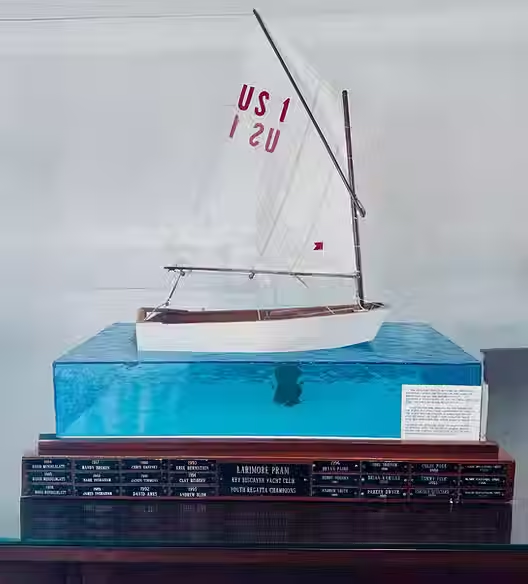
A Collective Portrait of Service - Governance History

Updated: Jul 23
Official record of the Key Biscayne Yacht Club Board of Governors, Flag, and Squadron Officers as of March 16, 2026. Presented by Historian P/C Hortensia Sampedro-Hacker and Committee Member Marta Clark.

KBYC: A Collective Record of Stewardship
These records represent our governance history, the names of all the men and women who have served as Board members and Squadron Officers of our Club since its inception in 1955.
This chart is more than a list of past officers and board members. It is a collective portrait of service—showing how hundreds of members, some briefly and others for decades, contributed to something larger than themselves.
The Key Biscayne Yacht Club has been sustained not by chance, but by generations of members who understood leadership as a long-term commitment to the Club’s past, present, and future.
This permanent record, originally organized by Commodore A. J. Larrea in November 1995, "intends to express our sincerest respect, appreciation, and gratitude for their honorable and valuable participation in Club matters and to establish a continued source of information and reference for future generations of members."
The first Commodore and each member of the Flag and Board of Governors, together with the first Seabelle who stepped forward in 1955, set a standard for others to follow. The Board was elected, and the Seabelle was appointed. As were the other Squadron leaders.
In 1977, the first positions of Fleet Captain and Fleet Surgeon were added to form the Squadron—appointments made by the Commodore. In 1993, the first Race Chair was appointed and joined the ranks of Squadron Officer. Several other firsts merit recognition: the first father-and-son Commodores, (modesty aside) the first woman Commodore, and most recently, the first father-and-daughter Commodores. And the first Cuban governor, reflecting the large flux into the Club in the 1960s.
It is our next task to compile the Yacht Register of the Club beginning with our Commodores. And to identify the various committees and chairs appointed through the years. This latter task will likely be undertaken after the Board Minutes and Key Cues are digitized so that the information can be searchable without spending hundreds of hours reading paper documents.
This information forms a real treasure trove for those interested in our history. Additional observations, patterns, and analytical insights emerge from these names and early entries. The advent of chatbots has facilitated this analysis and even made it fun. So, we leveraged AI to develop the additional commentaries.
We hope you enjoy this Collective Portrait of Service!
P/C Hortensia Sampedro HackerKBYC Historian, Chair, History Committee
February 3, 2026
Interpreting the Record –
Governance, Service, and Stewardship at the Key Biscayne Yacht Club
Introduction
The accompanying chart presents, in one consolidated view, the official historical record of the Key Biscayne Yacht Club’s governance and official leadership: Members of the Board of Governors and Squadron Officers across successive Watches. (This does not address Committee volunteers as that data is yet to be compiled.) While at first glance it may appear to be a chronological roster of names, closer examination reveals something far more meaningful—an enduring pattern of volunteer stewardship that has shaped the Club’s culture, stability, and continuity for seven decades.
This narrative is intended to help the Board of Governors and the Membership understand what this chart represents, what patterns emerge from it, and why those patterns matter to the Club’s history and future.
What the Chart Represents
At its core, the chart documents who served, in what capacity, and when. When analyzed in aggregate, it also reveals:
· The breadth of participation across the membership
· The depth of repeat service by a smaller core of leaders
· The governance model that evolved organically over time
· The scale of volunteer labor invested in the Club’s success
After cleaning and standardizing names to ensure accuracy, the record reflects:
· 649 distinct individuals who served in governance or leadership roles
· 1,622 recorded service instances, where one instance represents one role held in one year
· Average: ~2.5 roles per person
· Core leadership 7% of people deliver 27% of all service
Typical Peer Yacht Club
· Similar number of distinct volunteers over decades
· Average: 1.3–1.8 roles per person
· Core leadership (≥7 years): 2–4% of volunteers
KBYC has roughly double the “deep service” rate of peers.
Together, these figures represent a substantial and sustained commitment by generations of members. When viewed in comparison with peer yacht clubs of similar age, size, and standing, the patterns reflected in this chart place the Key Biscayne Yacht Club in a distinct category of governance culture.
Patterns of Service: Breadth and Depth
§ Broad Participation
Approximately two-thirds of all individuals in the record served once or twice. These members typically contributed through Board service or squadron leadership. This wide base of participation reflects a healthy and inclusive governance culture—one in which many members stepped forward to serve when called upon.
This pattern is consistent with comparable yacht clubs of similar size and era, where broad participation supports engagement and connection to the wider membership.
§ Sustained Engagement
About one-quarter of volunteers served three to six times, often across multiple years or roles. These individuals form the Club’s operational backbone, providing continuity between leadership cycles and preserving institutional knowledge.
While sustained service exists at most yacht clubs, KBYC’s record shows a larger and more consistent cohort of such contributors than is typical, indicating a preference for retaining experienced leaders rather than rotating roles rapidly.
§ Core Leadership
Most striking is a small but essential group—approximately 7% of volunteers—who appear seven or more times in the record. Though few in number, this group accounts for more than one-quarter of all recorded service. These individuals returned repeatedly to leadership roles over extended periods, often progressing through Board positions, Flag Offices, and post-Flag stewardship. Multi-decade leadership figures—individuals appearing ten or more times across Board and Flag roles—are comparatively rare at peer clubs but well represented in KBYC’s history.
In comparison with peer yacht clubs, this level of concentrated, long-term service is notably higher. Many comparable clubs rely on stricter term limits and faster leadership turnover, resulting in fewer multi-decade governance figures. KBYC’s history reflects a different choice: continuity through experience.
This “broad base, narrow spine” governance model—many participants supported by a smaller core of long-serving leaders—is a defining feature of KBYC’s institutional character.
§ Highest Repeat Service: Institutional Pillars
Within the core leadership group, a very small number of individuals stand out for exceptional repeat service, appearing 12 to 15 times across roles and years—an extraordinary level of commitment by any nonprofit or yacht club standard. (It is a classic “institutional pillar” curve.)
Top-tier repeat service includes:
· Timothy P. Stickney – 15
· W. Arthur Fielden – 15 †
· I. I. Probst – 14 †
· Hortensia Sampedro Hacker – 13
· Errol S. Cornell – 13 †
· Fred W. Thomas – 13 †
· Eduardo L. Hernandez – 13
† Deceased
Several of these individuals completed their service arcs decades ago and are no longer part of the Club’s active governance. Their cumulative service now stands as historical evidence of the depth of stewardship that shaped KBYC’s governance culture during formative and transitional periods. Through repeated service across multiple Watches, they carried institutional knowledge forward, preserved traditions, and established norms that later generations of leaders inherited rather than reinvented. These are not “one-year leaders”. They function as structural-load bearing members of the Club, spanning board roles, flag officer progression, and post-commodore stewardship. Governance by design, not coincidence.
§ Second Tier Repeat Services: Long-Term Stewards (10-12 Appearances)
Still well above norms for volunteer governance:
· Mortimer Fried – 12 †
· C. Raymond Shambaugh – 12 †
· Ronald W. Drucker – 12
· Douglas W. Biggers – 11 †
· Hubert B. Dates, Sr. – 11 †
· J. J. Donoghue – 10 †
· Louis P. Slater – 10 †
· Stuart D. Ames – 10
· Gary R. Gross – 10
† Deceased
This tier reflects deep bench strength. Likely overlaps heavily with: Board continuity, Financial oversight, Transition years. These individuals form the governance memory spine beneath the very top tier.
Seen in this light, these individuals, Institutional Pillars and Long-Term Stewards, represent not ongoing concentration, but foundational stewardship—completed leadership arcs that helped enable broader participation and successful succession in later years.
A Distinct Governance Culture in Context at KBYC
When viewed alongside comparable yacht clubs of similar age, size, and standing, the historical record places the Key Biscayne Yacht Club in a distinct governance category.
Where many peer clubs emphasize frequent rotation and short leadership tenures, KBYC has historically favored long leadership arcs, mentorship, and continuity. This approach does not diminish broad participation; rather, it complements it by ensuring that experience and institutional memory are carried forward from one generation of leaders to the next.
The result has been a governance culture marked by:
· Stability across decades
· Smooth leadership transitions
· Strong preservation of traditions
· A pronounced sense of custodial responsibility
These characteristics help explain the Club’s enduring identity and coherence over time.
The Scale of Volunteer Commitment
To better understand what these patterns represent in practical terms, service instances were conservatively translated into estimated volunteer hours based on typical governance responsibilities. Using this model, the chart reflects approximately:
· 137,000 hours of volunteer governance labor over the Club’s history. Typical Peer Club (same age) ~ 70,000 – 95,000 hours. KBYC’s governance labor intensity is ~ 40-80% higher than peers. Volunteers w/7+ roles are 7% at KBYC vs 2-4% at typical peer club.
This equates to roughly 65–70 full-time work years of service and $7 to $10 million in professional-equivalent labor. A substantial share of this effort was carried by the sustained and core leadership groups—members who returned year after year to shoulder responsibility for governance, continuity, and institutional stewardship.
Most clubs rotate leadership to avoid burnout or entrenchment. KBYC historically retains leadership to preserve culture and continuity. Neither is “wrong”—but they produce very different institutions.
Generational Transition and Continuity
Importantly, the record also reflects a healthy pattern of generational transition. Many of the individuals whose names appear most frequently in earlier decades are no longer active, yet the Club’s governance has continued to function with stability and continuity. This suggests that KBYC’s historic reliance on deep stewardship did not result in permanent concentration, but rather in the successful transfer of knowledge, responsibility, and culture from one generation of leaders to the next.
This ability to absorb transition while preserving identity is a defining strength of the Club’s governance tradition.
Stewardship and Professional Management: The Need for Balance
The historical record reflected in this chart also underscores an important governance principle: effective volunteer stewardship and professional management are not substitutes for
one another, but complements. KBYC’s tradition of deep, sustained volunteer leadership has been a source of continuity, institutional memory, and cultural coherence. At the same time, as the Club has grown in size, complexity, regulatory exposure, and operational scope, the role of professional management has become increasingly essential.
Balance between Volunteer Governance and Professional Management
When the balance between volunteer governance and professional management is well aligned, the Club benefits from the strengths of both: volunteers provide vision, values, and custodial responsibility, while professional staff deliver operational continuity, technical expertise, and day-to-day execution. However, when the pendulum swings too far in either direction, risks emerge.
An overreliance on volunteer leadership—particularly when concentrated among a small core—can unintentionally blur the line between governance and operations, strain individual leaders, slow decision-making, and place undue burden on those serving. Conversely, excessive delegation of authority to professional management without clear governance oversight can dilute institutional memory, weaken member engagement, and erode the Club’s distinctive character.
The KBYC Experience
The historical patterns documented here suggest that KBYC has long succeeded by valuing experience, continuity, and stewardship. The challenge for each generation of leadership is to honor that tradition while calibrating it thoughtfully to contemporary realities—ensuring that volunteer leaders govern, professional managers manage, and both work in partnership to sustain the Club’s mission, culture, and long-term health.
Seen in this light, the chart is not only a record of the past, but a guidepost for the future: a reminder that balance, clarity of roles, and mutual respect between volunteers and professionals are essential to preserving what makes the Key Biscayne Yacht Club enduring and exceptional.
A Living Record of Stewardship
This chart should not be read simply as a list of past officers and board members. It is a collective portrait of service, showing how hundreds of members—some briefly, others for decades—contributed to something larger than themselves.
Taken together, these records tell a consistent story:
The Key Biscayne Yacht Club has been sustained not by chance, but by generations of members who understood leadership as a long-term commitment to the Club’s past, present, and future.
Curated by H. Sampedro
March 6, 2026
Sources: Club Archives, ChatGPT, Claude
Footnote: What We’re Comparing Against (Peers)
Comparable clubs typically include:
· Regional flagship yacht clubs (1950s–1970s founding era)
· 400–900 member range
· Mix of sailing, power, social, and dining
· Volunteer boards with professional management
Think:
· East Coast & Gulf Coast yacht clubs
· Southern California clubs
· Long-established harbor clubs (not mega-clubs, not marina-based)
Most of these clubs do not publish longitudinal governance rosters, but patterns are well documented through:
· Board bylaws
· Commodore rolls
· Governance studies
· Nonprofit board benchmarks
Footnote: Observations, Patterns, and Analytical Takeaways from data structure and early entries.
1. Governance Structure Is Highly Stable and Traditional
Clear hierarchy, consistently maintained
· The leadership ladder is stable across years:
o Commodore → Vice Commodore → Rear Commodore → Secretary → Treasurer
· This reflects a deliberate succession model, not ad-hoc elections.
· The “Watch” numbering reinforces continuity and institutional memory.
This is classic yacht-club governance modeled on naval and British club traditions—strong continuity, minimal experimentation.
2. Strong Use of Repeat Leadership (Institutional Memory)
Names recur across roles and years
· Individuals often appear:
o First as BOG members
o Then Flag Officers
o Later as Immediate Past Commodore
· This suggests multi-year leadership investment, not one-year service.
Leadership is grown internally, not imported or rotated quickly.
This structure favors:
· Stability
· Shared norms
· Deep cultural continuity…but can also slow reform during moments of needed change.
3. Early Years Show Very Tight Governance Circles
Small, concentrated leadership group (1950s)
· Early boards are relatively compact.
· The same surnames appear repeatedly across:
o Flag Officer roles
o Board positions
o Squadron roles
This is typical of a founding-era club:
· Strong personal relationships
· Overlapping responsibilities
· High trust, low bureaucracy
4. Squadron Officers Are Structurally Secondary—but Symbolically Important
Fleet Captain, Race Chair, Fleet Surgeon appear later and lighter
· These roles:
o Are not always filled in early years
o Sometimes appear blank or inconsistently recorded
· Indicates they were initially functional roles, not governance power centers.
This reflects a period when:
· Social cohesion and governance mattered more than formalized race administration
· Competitive sailing infrastructure matured later
5. Seabelle Captain Is a Persistent, Standalone Role
Consistent presence
· The Seabelle Captain appears distinctly and reliably.
· Not absorbed into other offices.
· Treated as its own leadership lane.
This is not ceremonial—it signals:
· Early recognition of the social and cultural engine of the Club
· Parallel authority structure to the Flag Officers
This reinforces the Seabelles’ historic importance rather than treating them as auxiliary.